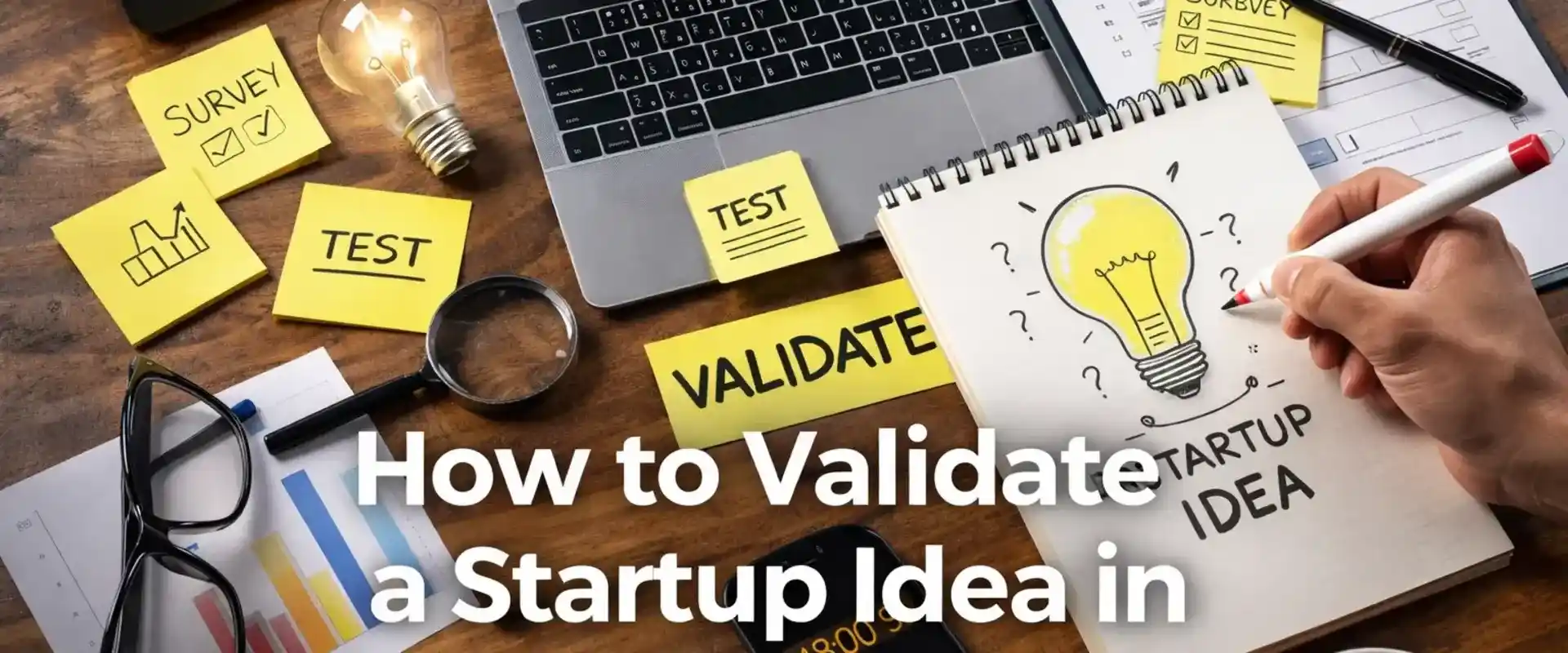
You have an idea. It keeps you up at night. You’ve already imagined the logo, the office, and the launch party. But before you spend a single dollar, you need to know how to validate a startup idea to ensure people actually want what you’re building.
That nagging voice in the back of your head asking “What if nobody wants this?” is a sign that you need a solid plan.
That fear is healthy. In fact, it can save you thousands of dollars.
Most new entrepreneurs make the same fatal mistake: they build the product first, and try to sell it second. In 2026, that is the fastest way to go broke. Whether you found a concept in our guide to top new startup ideas for 2026 or dreamt one up yourself, you need to test it before you build it.
This process is called Market Validation. It doesn’t require coding, it doesn’t require investors, and you can do it this weekend.
Here is the 4-step framework to validate a startup idea fast, know if your idea is gold, or garbage, in just 48 hours.
What Does it Mean to Validate a Startup Idea? (And Why You Need It)
Startup Validation is the process of verifying that people are willing to pay for your product before you actually create it. If you want to validate a startup idea correctly, you must answer two fundamental questions:
- Does this problem actually exist?
- Are people desperate enough to pay for a solution?
If the answer to either is “no,” you don’t have a business; you have a hobby.
Step 1: The “Mom Test” (Find the Pain)
Time required: 4 hours.
Do not ask your mom if she likes your idea. She loves you, so she will lie to you. She will say, “That sounds lovely, dear!” That is “false positive” data. It is dangerous.
To properly validate a startup idea, you need to talk to strangers who might be your future customers. But don’t mention your idea yet. Ask about their problems. Ask: “Tell me about the last time you encountered [Problem X].”
Ask these 3 Questions:
- “Tell me about the last time you encountered [Problem X].”
- “What did you do to solve it?”
- “How much did that solution cost you (in time or money)?”
The Red Flag: If they say, “I haven’t really dealt with that recently,” or “I just ignored it,” STOP. If the problem isn’t painful enough for them to remember, they won’t pay you to fix it.
Step 2: The “Smoke Test” (The Landing Page)
Time required: 3 hours.
Once you have confirmed the problem exists, the next phase to validate a startup idea is the “Smoke Test.” This is a one-page website that looks like a real product, even though the product doesn’t exist yet.
You are going to build a “Smoke Test.” This is a one-page website that looks like a real product, even though the product doesn’t exist yet.
What to include on the page:
- The Headline: A clear promise (e.g., “We help seniors set up their smart homes in 1 hour”).
- The Benefits: 3 bullet points explaining why it helps.
- The Call to Action (CTA): A button that says “Join Waitlist” or “Get Early Access.”
Tools to use (2026 Edition):
- Carrd.co: For building a simple, beautiful 1-page site in minutes.
- Tally Forms: For collecting emails when they click the button.
👉 Check out our list of essential AI business tools to automate your landing page setup.
Step 3: The Traffic Test (Get Eyeballs)
Time required: 24 hour.
A website with no traffic tells you nothing. You need to put your “Smoke Test” in front of real humans.
Where to post (for free):
- Reddit: Find the subreddit for your niche (e.g., r/AgingParents for senior care ideas). Write a genuine post asking for feedback on the concept, not just spamming the link.
- Facebook Groups: Local community groups are gold for service-based businesses.
- LinkedIn: Best for B2B (Business-to-Business) ideas.
The Rule: Do not beg. Just say, “I’m working on a project to solve [Problem]. Is this something you would use?”
Step 4: The Currency of Truth
Time required: Analysis
How do you know if you passed the test? You look for Currency.
In the validation phase, there are two types of currency:
- Email Addresses: This is “Interest Currency.” If 20 strangers give you their email, you are on to something.
- Money: This is “Hard Currency.” If you put a “Pre-Order for $5” button up and people actually click it, you have a winner.
The 10% Benchmark:
If 100 people visit your page and 0 sign up, your idea (or your wording) is bad.
If 100 people visit and 10 sign up (10% conversion), you have a validated idea. Start building.
Common Validation Mistakes
1. I need to build the prototype first.
No, you don’t. Dropbox started with just a video explaining what it would do. They got 70,000 signups in one night without writing a line of code.
2. Someone will steal my idea.
This is the biggest myth in business. Ideas are cheap; execution is hard. Investors and competitors are too busy with their own problems to steal your unproven idea. Share it freely to get feedback.
3. I’ll ask my friends.
Your friends want to be supportive. They are not your customers. Validate with strangers.
Final Thoughts: Why Learning to Validate a Startup Idea Saves You Time
It sounds strange, but if you go through this 48-hour process and nobody signs up, celebrate.
You just saved yourself months of work and thousands of dollars building a product nobody wanted. Now, you can move on to your next idea with a clear head.
But if they did sign up? Then you have the green light. You aren’t guessing anymore; you are executing.
Still looking for that winning concept?
If this idea didn’t work out, don’t worry. Go back to our master guide on profitable business concepts and pick the next one to test.